On Remembrance
How happy is the blameless vestal's lot! The world forgetting, by the world forgot.

Nestled amongst the excitement and adrenaline of the high school debate tournament our university hosted last February was a quiet moment of captivation I felt listening to the grand finals of the competition. What stuck with me was the topic of the debate, an outline of the plot of Eternal Sunshine of the Spotless Mind. While the film was fascinating enough, I put it off, in the back of my mind (ironically) for months until it finally occurred to me, amid a whirlwind of emotions this summer, to watch it for the first time. Thanks for the inspiration, Caitlin.
The premise of the movie (and the debate topic) is innocuous enough. A man, Joel, breaks up with his girlfriend, Clementine, after a bittersweet relationship, only to learn (accidentally) that she chose to undergo a procedure that erased all her memories of their relationship. While he recalls the happy moments during their time together, he can’t help but recollect the messy and broken ending to their love, a weight compounded by the knowledge that she’s been living a pain-free life without him. Heartbroken, Joel decides to undergo the same procedure.
Back then, it made no sense to me why people would want to give up such a core part of them, especially since those memories were mostly happy. But now, I realize it’s more nuanced than “at least I’ll be able to recall the good times we had.” Some memories are difficult to hold onto without being consumed by the pain and anguish. I think it’s difficult to comprehend losing that connection unless you truly experience it firsthand. In that moment of loss, of emotional deprivation, the grief consumes you. It takes up every second of your thoughts. It makes you question whether you’ll ever find anything like it again. That’s the tradeoff Joel was considering.
But regardless of the suffering we go through, I’d argue these memories, with the people we care about, are something worth holding on to until the day we die. The price we pay to cling to the only living records of our past, whether it be through the photos we take or the messages we’ve saved of our conversations, is one worth paying. There are broadly five reasons I’ve come to realize for this.
First, memories are inalienable. They are the only things not materially bound to our world, not temporally bound to the present. Unless you deliberately attempt to, you won’t ever lose the moments you’ve shared with someone, even after they’re no longer with you. When I lost my grandfather to cancer, I knew he wouldn’t ever be in another one of our family pictures. But no one could ever take away the hours we spent skipping rocks in Banff, nor the sweet aroma of the 蛋花汤 (egg drop soup) he would make for me every morning. I’ll never forget the time he walked me three kilometres to school because I missed the bus. He was quite reserved, and always modest in his demeanour, but had the most outstanding character out of anyone I’ve ever known.
Second, memories are unique to you. Other people may be in the same position you once were, whether it be a new father or mother, a new friend, or a new acquaintance. But they will never possess the same experiences you shared with the person you lost. While I don’t mean to sound philosophical, I do think there is something deeply significant in understanding that no one else will ever be able to replicate the scenes you could in your head, and by extension, an integral part of your identity. All of the moments I shared with my elementary school friends, playing video games at their birthday parties, riding along in our school bus singing along (poorly) to 2010s pop songs. This exclusivity matters because we spend our lives trying to attain some level of individuality; we’d rather not fit in, but be different, because it grants us the agency to chart our paths in life.
Third, memories teach you important lessons that necessitate the level of suffering and regret they evoke. It helps you understand yourself and your own identity, because you dedicate so much of your life to someone, to learn more about them. And in that process, you inevitably learn so much about yourself too. You’re able to better recognize your own flaws, come to terms with your trauma, and realize how these things influenced the decisions, good and poor, you made.
Even more compellingly: the uniqueness of owning your memories means that you know if you forget them, you lose them permanently; no one else can recover them for you. Once we opt to sever that connection and cast those lessons away permanently, we lose not only a core part of ourselves but also the experience and wisdom we gained. And that makes us want to hold onto them all the stronger.
Fourth, memories are a special source of happiness. It’s the warm feeling that embraced me as I look back on the photos we took during our camping trip, singing songs and roasting marshmallows around the bonfire. It’s the awestruck wonder that fills me when I think back to that one starry night when we sat on the beach, gazing up at the sky and pointing out constellations. I still replay these scenes in my head; I still feel the sensations no less real than in the moment. And like anyone else, I have had my fair share of unhappy moments in those memories — but that contrast between good and bad is what defines happiness and makes it all the more valuable.
Fifth, memories are a sanctuary that persists through time. No matter how much life changes, and people grow and drift apart from each other, the past will always remain. Perhaps that’s why watching the final scene from La La Land was heartbreaking — knowing that you can lose someone physically but still find each other again, one day. The way Sebastian sees Mia, hesitates as he sits down and plays their song, and imagines a life with them together. He won’t be the person sitting next to her, holding her hand, sharing the future she’ll have created. But in the film’s last scene, when the two of them locked eyes after all those years, there was no doubt they still loved each other and would forever cherish the memories they had of each other.

This is why I think, looking back to Eternal Sunshine of the Spotless Mind, the story of Joel and Clementine was so poignant in its depiction of human memory.
While there is no exact real-life parallel for the memory removal procedure portrayed in the movie, run by a fictional company called Lacuna, there is a pretty close analogy. Our way of retaining memories is by holding onto photographs of the ones we love, the cards they wrote us, the words they whispered to us in the dead of night, while no one else was around. Conversely, then, to abandon those memories is to relinquish that physical evidence of our connection to each other. While there is no clear antagonist in the film, I think that what Lacuna does is morally reprehensible. Their company ultimately exploits our aversion to pain to coerce us to surrender the few things that connect us to our past. Pain is temporary, but loss is permanent.
I think the film beautifully depicts Joel’s struggle against the system, and his desire to reclaim his memories once he comes to realize the value of his thoughts. He’s not a conventional protagonist by any measure — he’s massively flawed as a character; angry, irritable, immature. But despite all his shortcomings, what’s admirable, and subtly underlies the entire movie, is his determination to fight to protect his memories, to have the self-respect and dignity to embrace his past relationship, even the unpleasant parts. Perhaps Clementine thought her life would be so much better off having erased Joel from the vestiges of her mind, that she could attain an “eternal sunshine.” And, who’s to say she didn’t? But we see she regretted it when she played the records back at the end of the film and decided to try again with Joel.
I thought the scenes where he and Clementine hide within his memories seem comical at first, but as the scenes progress, we see the disappearance of his thoughts become more and more pronounced; random objects from his mind vanishing, the beach house collapsing in on itself. I think this is a subtle portrayal of how horrifying it is to (even if slowly and progressively) leave behind such an integral part of our identity. Eventually, the loss accelerates, solidifies, and becomes permanent; just like if we leave behind the evidence of our past, if we stop thinking about them, if we stop caring, we will inevitably revert to vessels of our former selves.

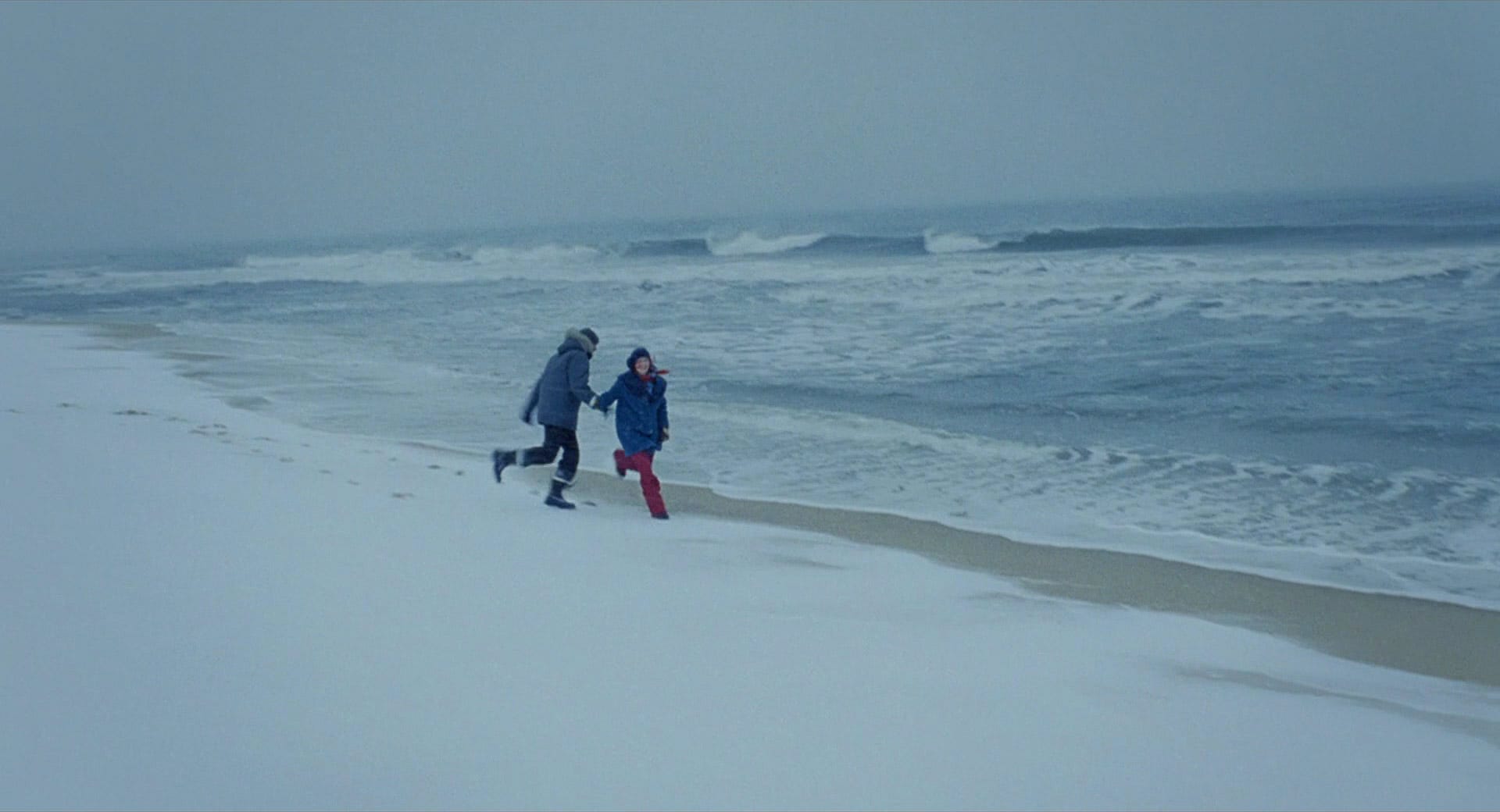
We all have our special place, the “Montauk beach” that Joel and Clementine traverse in their final memory together. And while life is not a movie and very rarely do we have the opportunity to get those relationships back after they’re gone, what is consistent with the film is our ability to revisit our most intimate moments, to go back to those unforgettable scenes that replay in our mind. Memory is a painful, yet beautiful part of the human condition. I’d argue, then, that the ability to create these memories, to be able to wield this metaphorical fire, is what makes life worthwhile.
Why are we so willing to dedicate our entire life to chasing ephemeral things, but then are unwilling to relive those special moments? We don’t care about the present because of the short-term happiness it provides us, but because it gives us the agency to continue remembering. Because memories last much longer, and are felt much deeper, than the sensations we experience in the moment of the event. Every experience you have in a friendship, every meeting or trip you go on is a continuation of the bond you share. Fundamentally, I think we all have a desire to continue building on our memories, to continue erecting a cathedral in our mind that we can come back to over and over.
What’s both amazing and terrifying about relationships is that they require constant maintenance and care. In The Little Prince, Antoine Saint-Exupéry depicts this quite poignantly — that in the process of connecting with someone, “you become responsible, forever, for what you have tamed;” that “one runs the risk of weeping a little, if one lets himself be tamed.” But as scary as it is, remembrance is what allows me to hold on — and I want to hold on. My memory of the people I care about, even for those who may not ever be around me again, or those whose paths I will never cross again, will never fade, as long as the memory of them lingers. I can’t say I’m fully happy to be where I’m at right now, but I can say I’m grateful to have had the opportunity to make and continue making, memories of a lifetime.